
Nervous System and Stress Patient Education for Your Clinic
By: Carolyn Vandyken, BHSc (PT), CredMDT, CCMA ∙ Estimated reading time: 3 minutes
By: Carolyn Vandyken, BHSc (PT), CredMDT, CCMA ∙ Estimated reading time: 3 minutes
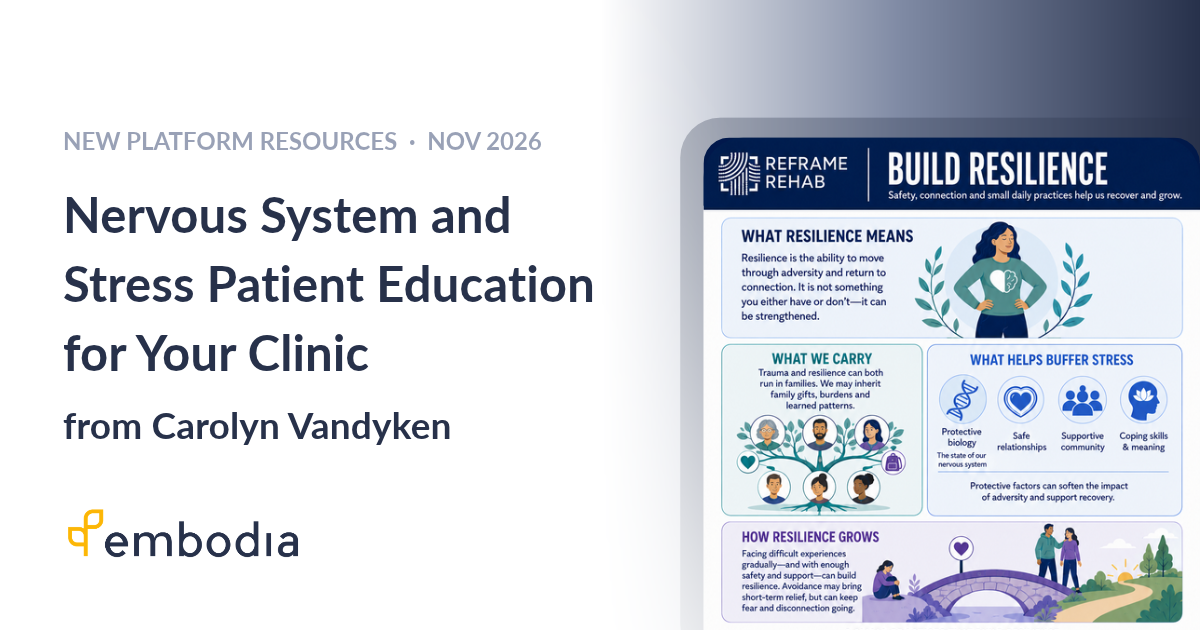
New Nervous System, Stress, and Resilience Education by Carolyn Vandyken
Your patient has done everything right. They've come to every session, they've done their exercises, and their tissues should have settled weeks ago. Yet they arrive today flat, exhausted, and foggy, and they tell you they feel like they're failing.
You know this isn't a motivation problem. It's a nervous system that has spent too long in protection mode. The hard part is helping your patient understand that, in language that feels reassuring rather than clinical, and giving them something practical to do between sessions.
Embodia's patient education library now includes ten new resources created by Carolyn Vandyken, BHSc (PT), CredMDT, CCMA, of Reframe Rehab. Together they help your patients understand how stress, arousal, beliefs, and self-talk shape their pain, and what they can do about it.
Why Nervous System Education Belongs in Rehab
Most of your patients have never heard that pain can persist after tissues heal, or that freeze and shutdown are protective states rather than personal failings. Without that context, they often read a flare-up as damage and a low-energy week as weakness.
Good education changes the story. When patients can name the state they're in, they're more likely to respond with regulation instead of fear or self-criticism. That shift supports everything else you're doing, from graded activity to your home exercise program.
These resources give you a consistent, plain-language way to have that conversation. They're written to reassure without minimizing, so patients feel understood rather than dismissed.
What's in the Collection
Understanding Stress and Arousal
- The Window of Tolerance: explains hyperarousal, hypoarousal, and the optimal zone in between, with strategies matched to each state.
- When Stress Becomes Trauma: shows how normal stress turns into overwhelm when capacity is exceeded, and frames fight, flight, freeze, and collapse as protective responses rather than weakness.
- Supporting a Chronic Freeze Response: a practical plan for when your patient's system powers down, including what to avoid and how to prepare for next time.
How Stress and Beliefs Drive Pain
- Chronic Stress, Cortisol Dysfunction, and Pain: maps the pathway from a stressor through HPA axis activation to inflammation, pain, and depression, based on Hannibal and Bishop's 2014 paper in Physical Therapy.
- How We Think Drives Our Pain and Disability: contrasts unhelpful and helpful pain beliefs and shows how each leads toward persistence or recovery.
Building Regulation and Resilience
- Self-Compassion: introduces mindfulness, common humanity, and self-kindness, with a simple morning, daytime, and evening practice.
- Build Resilience: explains what buffers stress and how resilience grows, then offers six small daily practices.
- Mindfulness & Meditation: covers primary and secondary suffering, and the balance between doing and being.
- Yoga Practice for Persistent Pain: includes five questions patients can ask during any activity, plus a section on yin yoga for the hips and pelvis.
- Qi Gong: describes gentle, adaptable movement and breath that work standing or seated.
How to Use It With Your Patients
At assessment. If your patient's pain behaves in ways tissue findings don't explain, share The Window of Tolerance or How We Think Drives Our Pain and Disability early. Both give you a shared language for the rest of care.
During a flare or a low week. Supporting a Chronic Freeze Response gives your patient permission to rest and a simple plan to follow, so a hard week doesn't become a reason to drop out of care.
As a homework companion. Self-Compassion and Build Resilience work well alongside your exercise program. Pair them with Mindfulness & Meditation, Yoga Practice for Persistent Pain, or Qi Gong, depending on what your patient is drawn to. Here's a sample of a lower Qi Gong video available to prescribe to patients on Embodia
When you need to explain the why. Chronic Stress, Cortisol Dysfunction, and Pain is the most detailed piece in the set. It suits patients who want to understand the biology, and it's a useful visual when you're explaining why stress management is part of your plan.
You can share each resource directly with your patients through Embodia, so they have it on hand between sessions.
Find the New Resources on Embodia
All ten resources are available now in Embodia's patient education library for Tier 2 and Tier 3 members, ready to share with your patients.
Looking for the lifestyle side of the story? Read our companion post, Inflammation and Lifestyle Patient Education for Your Clinic.
Want to go deeper with Carolyn? Her Year of Mentorship program builds the clinical reasoning behind this whole-person approach. Register for Year of Mentorship 2027.
Register for Year of Mentorship 2027
---
Last update: 16 Nov 2026

BHSc (PT), CredMDT, CCMA
Carolyn is the co-owner of Reframe Rehab, a teaching company engaged in breaking down the barriers internationally between pelvic health, orthopaedics and pain science. Carolyn has practiced in orthopaedics and pelvic health for the past 40 years. She is a McKenzie Credentialled physiotherapist (1999), certified in acupuncture (2002), and obtained a certificate in Cognitive Behavioural Therapy (CBT) in 2017.
Carolyn received the YWCA Women of Distinction award (2004) and the distinguished Education Award from the OPA (2015). Carolyn was also awarded the Medal of Distinction from the Canadian Physiotherapy Association in 2021 for her work in pelvic health and pain science.
Carolyn has been heavily involved in post-graduate pelvic health education, research in lumbopelvic pain, speaking at numerous international conferences and writing books and chapters for the past twenty years in pelvic health, orthopaedics and pain science.